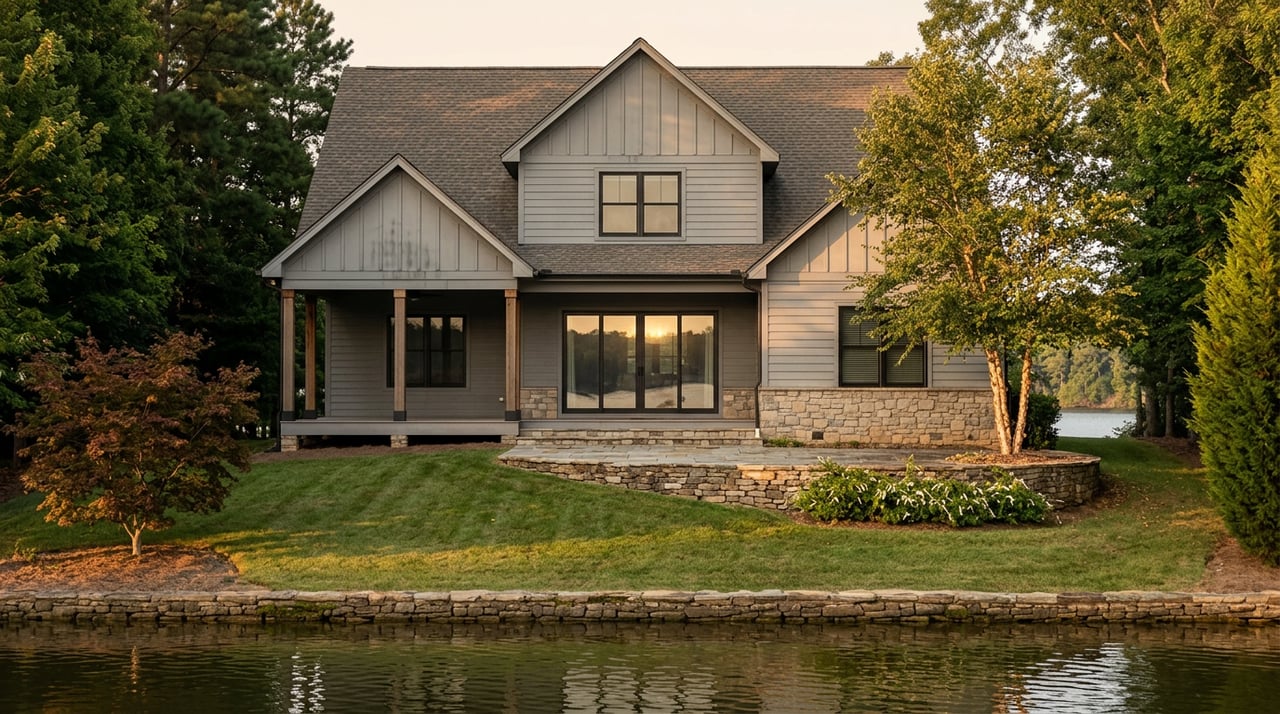
Kerr Lake Dock Permit Rules Every Buyer Should Know
August 13, 2026
August 13, 2026
Two homes are for sale on Kerr Lake right now that make the same promise in different languages. One is new construction, and the listing leads with the good news: the dock permit is already secured, so the buyer can build the dock of their choosing the day they close. Another sits on a lot bordered by Army Corps of Engineers land on two sides, with water at the doorstep and a sandy path down to a quiet cove, and its listing carries the opposite disclosure: because the shoreline belongs to the Corps, a private dock is not permitted here at all.
Same lake. Comparable distance to a boat ramp. Two completely different answers to the one question that decides whether a lake house works the way a buyer imagines it will.
This is the detail that trips up people moving to Kerr Lake or Buggs Island Lake from a lake with a homeowners association, where a developer decides who gets a slip. Here, the water and most of the surrounding shoreline belong to the U.S. Army Corps of Engineers, which built and still manages the John H. Kerr Reservoir. Whether a specific house can ever have a private dock is not a matter of what the deed says. It is a matter of federal permitting rules applied lot by lot, and those rules do not treat every waterfront parcel the same.
The reservoir spans nearly 50,000 acres with more than 800 miles of shoreline, straddling the North Carolina and Virginia line. Most of that shoreline is federal land managed under a document called the Shoreline Management Plan, which the Corps' Wilmington District office revises roughly every two decades. That plan, not the county, not the seller, and not the listing agent, determines which parcels are even eligible to apply for a dock permit.
That distinction matters because a house can touch the lake and still not qualify. A dock permit is a use granted for a specific, measurable piece of shoreline, and the measurements are unforgiving.
To be considered for a floating dock at all, a property needs at least 50 feet of common boundary with Corps-owned property. Fall short of that and the options narrow fast. Lots with between 20 and 50 feet of common boundary can sometimes get a permit for a walkway or for clearing vegetation, but they do not qualify for an actual dock. Lots that are extremely narrow, extremely shallow, or shaped like a finger reaching into the water are excluded outright, regardless of how much frontage they show on paper.
Then there is a separate category called Protected Shoreline, set aside for aesthetic and wildlife reasons. Docks already permitted there before the current plan took effect are honored for existing and future owners as long as the permit stays in good standing. No new permits are issued in these zones, ever. If a Protected Shoreline dock is ever lost, it does not come back.
Here is how that breaks down for a buyer comparing lots:
| Shoreline Classification | New Dock Permit Possible? | What a Buyer Actually Gets |
|---|---|---|
| 50+ feet of common Corps boundary, adequate depth | Yes, eligible to apply | A path to a private dock, pending approval |
| 20 to 50 feet of common boundary | No dock, walkway or clearing only | Water access, no slip |
| Finger lot | No, regardless of frontage | Water views, no dock rights |
| Protected Shoreline | No new permits issued | Only an existing, transferable permit has value |
Even a lot that clears every threshold does not get an open-ended dock. Docks without a boat slip are capped at 320 square feet. Docks with a slip max out at 960 square feet. A buyer picturing a boathouse big enough for two pontoon boats and a covered sitting area needs to know that ceiling exists before falling in love with a lot, not after.
This is not a theoretical inconvenience. When the Corps was rewriting the Shoreline Management Plan, it froze new dock permits for the entire process, a stretch that stretched to nearly three years. The Mecklenburg Sun reported that real estate agents and dock builders around the lake blamed the freeze for putting a real drag on sales and development, since buyers were not willing to close on lake property without knowing whether they would ever be allowed to put a boat at their own dock. The rules Kerr Lake buyers work with today, including the 50-foot threshold and the size caps, are what came out of that rewrite once it finally published. Permit status is not paperwork trivia. It has moved actual transactions on this lake before, and it can again.
There is one more wrinkle worth slowing down for. Some existing dock permits are not tied to the land itself but to a deed of easement between two neighboring owners. Under current rules, permits linked to that kind of easement expire the moment either property changes hands, whether through a sale or otherwise. A buyer could walk into a closing believing a dock permit transfers automatically with the house, only to find out later that the very transaction that made them the owner is what ended the permit.
A few questions, asked before the offer goes in rather than after the inspection period closes, settle almost all of this:
Does every home for sale on Kerr Lake come with dock rights? No. Water access and dock rights are separate questions. Some homes sit directly on the water with no eligibility for a private dock because of frontage, lot shape, or a Protected Shoreline designation.
Can a buyer apply for a new dock permit after closing if one does not already exist? Sometimes, if the lot meets the frontage and classification requirements. Approval is not automatic, which is exactly why it belongs on the pre-offer checklist rather than the post-closing to-do list.
Is Buggs Island Lake a different body of water from Kerr Lake? No. It is the same reservoir, called Kerr Lake on the North Carolina side and Buggs Island Lake on the Virginia side, and the same Corps rules apply on both shorelines, along with public access points like those inside the Kerr Lake State Recreation Area.
A dock is often the reason someone buys on this lake in the first place. Knowing whether a specific lot can actually have one, and whether that right survives the sale, is worth more than any square footage number on the listing sheet. If you are comparing waterfront on Kerr Lake or Buggs Island Lake and want someone who will run these questions down before you write an offer, Key Realty Team is ready to help you unlock your real estate dreams.
Stay up to date on the latest real estate trends.

We invite driven professionals to grow within a collaborative environment defined by integrity, refinement, and results.